After a recent event at which I played electric guitar, a woman approached me with a prophetic word:
Not a very uplifting prophecy! My first impulse was to reason, "I am only the guitar player, and I am not even in the system." But I went home thinking heavily about what she had said, and I had to review my actions the way God does--against the knowledge I have and what I did or did not do with it. And, in the end, I fell short.
First, as one should always ask about a prophetic word, was it consistent with the Bible? (and, yes, I believe that as long as people need exhortation, comfort, or encouragement, God will continue to use prophecy and other spiritual gifts through his people). In essence, she was saying, love your brothers and sisters enough to not hurt them. I cannot think of a more biblical message than that. Also, it was uncanny that she came to me, the guitar player, even though she did not know that I probably have more training in acoustics than any of the other two or three hundred people there. She also did not know that I was inadvertently "taking data" that could confirm whether the levels were indeed dangerous. For all these reasons I regard the prophecy as genuine and feel the need to respond.
The "data" I mentioned comes from a recording of the service I made using my Zoom H4 positioned at the back row of the audience. Being severely afflicted with geekitis, I had calibrated the unit with my own sound level meter (SLM), and I knew how to import a wav file into analysis software and compute the levels (I entered engineering because of my love for and study of acoustics, and I have spent half of my 11-year career in acoustics; I have gotten paid very good money to measure and analyze sound).
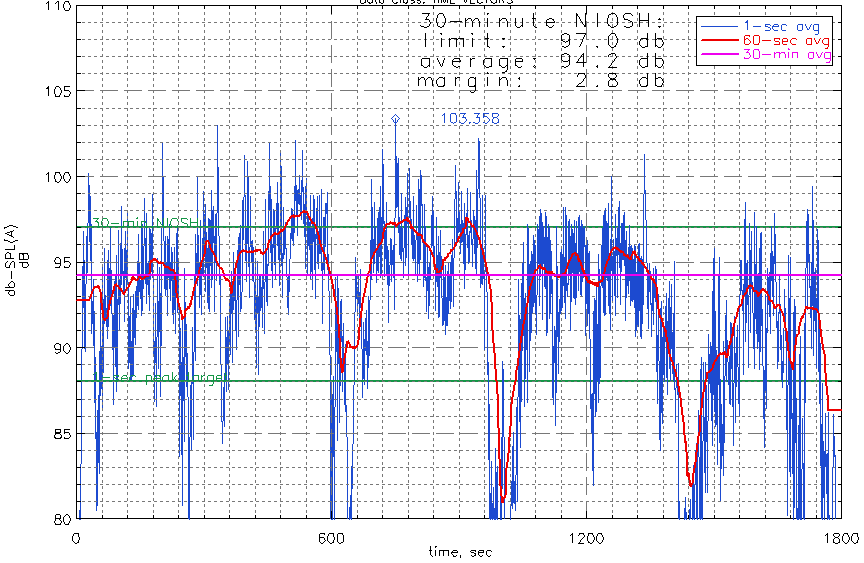
The portable recorder was located in the back row, about 70 feet from the stage front and main speakers. Here is the sound-pressure-level history:
The one-second average represents what one would see holding an SLM set to dB-A with slow response. This is the measurement we want to set levels by. However, recommended limits are for long-term averages and depend on the time of exposure. They describe the probability that a given fraction of the population will experience hearing loss resulting from exposure to the given sound levels. I am familiar with two sources: The Occupational Safety and Health Administration (OSHA) and the National Institute for Occupational Safety and Health (NIOSH). Here are their published SPL limits:
| exposure time |
OSHA (dBA) |
NIOSH (dBA) |
| 8 hour | 90 | 85 |
| 4 hour | 95 | 88 |
| 2 hour | 100 | 91 |
| 1 hour | 105 | 94 |
| 30 min | 110 | 97 |
| 15 min | 115 | 100 |
| 7.5 min | 120 | 103 |
| 3.25 min | 125 | 106 |
I don't know exactly why NIOSH is so much more conservative than OSHA; it may be that OSHA is a regulated limit and NIOSH is a recommended limit. At any rate, I use the NIOSH recommendation and agree, based on my own subjective impressions, that these levels sound loud.
A typical worship service (at least, the loud part involving music and singing) is 30 minutes, so a time-average level of 97 dBA is an upper limit according to the NIOSH table. As the figure above shows, the level at the back row was 94 dBA. Therefore listeners at the back row, while experiencing "loud" levels, had a safety margin of 3 db against the upper limit. But that is only the back row.
Years ago I wrote WinSound for just this type of situation. From my limited experience and listening to the recording, I would estimate that half the level at the back row was from the reverberant field, so the direct sound would be about 91 dBA. Using this assumption, I made a crude WinSound analysis that predicts the distribution in direct levels:
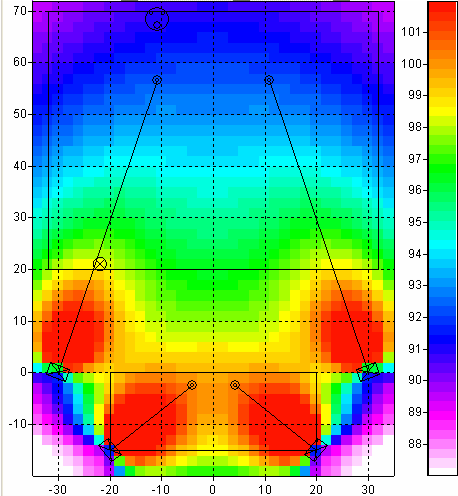
The "Mr. Bill" face at the top represents the Zoom H4 at the back row where the direct level is set to 91 dBA. The predicted distribution shows, first of all, that approximately one third of the audience experienced the NIOSH limit of 97 dBA (a 91-db reverberant level added to a 96-db direct level equals 97 db, the onset of the green color band). Second, the worst-case front-row seats may have experienced direct levels as high as 99 dBA--that is, total level of about 100 dBA, 3-db above the NIOSH limit.
So the answer is, yes, while no one was exposed to the OSHA limit of 110 dBA, still we dropped the ball and allowed the levels to get too high. Consequently, I feel the need to change my approach to live music to make sure I am part of the solution, and not the problem, from now on.
Interestingly, comments on the levels were split 50-50 with some saying it was perfect and others saying it was too loud. This shows the highly subjective nature of sound and the variation in taste. There is still not enough people educated about this topic, so many concerts and worship services run at very high levels (105-115 dBA) often exceeding even OSHA limits. Unless people understand the danger enough to detect its presence, it simply goes undetected, and dangerous sound levels seem natural.
A typical home stereo is listened to at a level of 85 dBA. However, a worship service also involves the singing and clapping of the audience, and this tends to elevate the preferred level. In my own experiments, I have found that I prefer a level of 88-92 dBA. Below 88 dBA I feel like my voice is inordinately loud, and I reduce my singing or clapping or stop entirely. Above 92 dBA I begin to feel the level is too high, and it makes me nervous and distracted. At about 95 dBA I reach for my ear plugs (as I did that night). By the way, I have had my ears checked and was told I can "hear the grass grow." I think I sing quite loud, so my preferences probably represent a target for the front row while listeners who prefer lower levels should be accommodated in quieter sections of the audience.
If we accept a peak target of 92 db for the loudest seats, then the direct sound would be at 91 dBA, and the reverberant field would be at 83 dBA. That would put the back row peaks at 87 dBA. With typical peaks at 99 dBA (that is, peaks that would be normally observed on an SLM), I conclude that the levels could have been reduced by 12 db without sacrificing singability.
A number of factors contributed to the situation:
Here is how the event went for me: I arrived 2.5 hours before start of service and learned that we only really had 2 hours to set up since the half hour preceding needed to be quiet. The service was held at a rented room, not a church, so nothing was set up. When we finally were ready, we had about 15 minutes for the sound check. But, with no sound technician, we took turns listening and offering suggestions, and this makes for slow progress. When time ran out, a couple of the musicians commented that it was loud. One of us reasoned that the audience would "soak up" a lot of the sound when they got there. Knowing this was a true, but negligible, effect, I reached in my baggage and got my ear plugs so they would be ready--just in case. I reasoned that there was no time to wage a technical debate on audience absorption coefficients and their effect on reverberation (small) and direct levels (zero). Besides, we had no time to fix the mix even if we wanted to. A couple minutes into the first song, I felt the nervousness I get around 95 dBA and put my ear plugs in worrying about all the people that didn't have any. After the first song there was a long greeting. I took the opportunity to make sure I was not contributing to the high levels by moving my amp. It had been 10 feet behind me pointing into the audience, so I brought it within 5 feet and aimed it straight at my head. That way, if my guitar sounded right to me, it would certainly be too low for everyone else (I can't hear a note I played in the recording).
My first, and most obvious error, was in not bringing my SLM. As mentioned, the perception of sound level is very subjective and easily influenced by emotions--we all tend to hear what we want to hear (I am the worst offender). I had gotten complacent and figured somebody else would take care of the levels.
My second, and worst error, was in not speaking up. I should have delayed the service and taken the blame for it. Knowing I might need earplugs was all the information I should have needed.
My third error was in not asking questions up front about the equipment, and, most importantly, the technician.
First, I will not agree to play until I receive satisfactory answers to the following questions:
Second, I will bring my SLM to all events I play at to guarantee that one is available.
Finally, I will endeavor to educate fellow laborers about sound and hearing. Here is a start:
If you are a musician (or otherwise involved in live sound), please educate yourself about sound levels and hearing damage. Buy an SLM. Conserve your own hearing--not only because it is precious in itself, but also consider: if your hearing is damaged, you will turn your monitor up louder driving other levels louder. That will accelerate your own hearing damage while making the sound more difficult for the technician to control.
If you are a sound technician, please accept my humble gratitude for your contribution. I realize you get forgotten when you do well (if you're lucky) and bashed if you don't. Then, in addition to sound levels and hearing damage, please educate yourself on speakers, directivity, frequency response, reverberation, inverse-square attenuation (6db per distance doubling), compressor-limiters, and clipping. Get a copy of the Yamaha Sound Reinforcement Handbook (or borrow mine) and read it. Log on to ChurchSoundCheck.com and read some of the articles. Take a seminar from Syn-Aud-Con.
I have always enjoyed analyzing acoustics--until now. This was not a fun analysis. Nor are these admissions pleasant to make. But, given my background on the topic, I feel convicted that I should take the lead. This is the essence of repentance--acknowledging that my behavior has not been what it should be and making a deliberate reversal. I will venture to guess that this has not been a fun article to read either. But I will hope that you will accept my invitation to work together and raise the bar on worship musicianship to a level of responsibility that the name of Christ deserves. Then, may He see our works and bless them.
Sincerely,
Will Spicher
back to WillSongs
published 02-aug-2007